
Ausbildung profession · Dairy and food industry
Milchtechnologe Ausbildung in Germany: dairy technologist
A dairy technologist (Milchtechnologe) turns fresh milk into cheese, yoghurt, butter or milk powder, using modern machines and under very strict hygiene rules. Almost nobody outside Germany has heard of this profession, yet it is the best-paid Ausbildung in the country.

 ProvenExpertTop service provider and top recommendation 2025
 Unternehmen der ZukunftAward from a German innovation institute
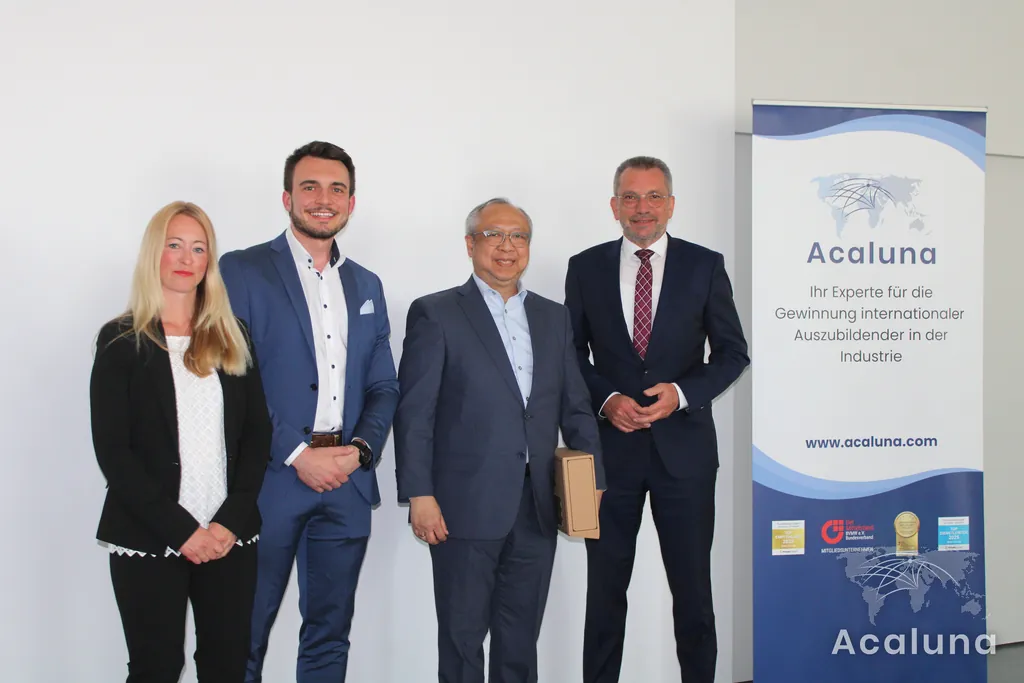 Indonesian Consul Generalvisited our office, 2025
Press
Schwäbische Zeitungreported on Acaluna, April 2025
HRB 746028
German companyregistered at Ulm District Court
Indonesian Consul Generalvisited our office, 2025
Press
Schwäbische Zeitungreported on Acaluna, April 2025
HRB 746028
German companyregistered at Ulm District Court
- German name
- Milchtechnologe
- Duration
- 3 years
- Field
- Dairy and food industry
- Where you work
- Dairies, often in small towns or rural areas
- Training pay
- 1,463 euros a month on average (2025)
- Language
- German, usually B1 for the visa

What you do every day
- Receiving fresh milk from tanker trucks and checking its quality
- Running and monitoring pasteurisers, cheese vats or milk-powder dryers
- Setting temperatures, times and recipes on the control panel
- Taking samples and running quality tests in the laboratory
- Cleaning and sterilising the equipment according to hygiene rules
Pay during the Ausbildung
According to BIBB, dairy technologist was the best-paid Ausbildung in Germany in 2025: on average 1,463 euros gross a month in companies with a collective agreement, across all training years. The exact amount depends on the company and the region.
These are gross figures. Social insurance contributions are deducted, and living costs in Germany are high. Our salary guide shows what is left after rent, food and insurance. For the visa, your training pay should be at least 1,048 euros gross a month (2026), otherwise you have to show extra funds.
Working hours and shifts
Many plants produce day and night. In many companies, night, weekend and shift work is paid with extra allowances on top of the basic training pay. Under German law, apprentices under 18 may not work night shifts.
Career after the Ausbildung
Qualified dairy technologists work in production or in the laboratory. With experience you can go on to become a Meister (production master) or a state-certified Techniker in food technology and lead your own team.
After the Ausbildung you can stay in Germany as a skilled worker. In many industrial professions, skilled workers earn more than twice the training pay. Read after the Ausbildung for the residence rules.
This profession suits you if …
- You like biology, chemistry or maths
- You work carefully and can keep things very clean
- You do not mind shift work
It may not suit you if …
- You cannot stand the smell of milk and cheese
- You only want to live in a big city
Questions about this Ausbildung
The Ausbildung as dairy technologist (Milchtechnologe) takes 3 years. It is a dual training: most of the week you work in the company, the rest you spend at a vocational school. With very good results, the training can sometimes be shortened.
According to BIBB, the average was 1,463 euros gross a month in 2025 in companies with a collective agreement, averaged across all training years. Pay rises every year of the training. The legal minimum in the first year is 724 euros a month for a start in 2026.
Yes. From outside the EU you need a training contract with a German company, German at level B1 and a visa for vocational training. Because few German school-leavers know this profession, companies are often open to applicants from abroad. Vocational school and the final exam are in German.
Interested in this profession?
Acaluna places apprentices from Indonesia in this profession with German companies that commission us. If you live in Indonesia, have finished 12 years of school and hold a German B1 certificate, check in one minute whether you can apply.
Pay: Federal Institute for Vocational Education and Training (BIBB), collectively agreed training pay 2025. Profession details: Federal Employment Agency (BERUFENET). Status: September 2026. Which professions we offer each year depends on the needs of the companies that commission us. Also available in Bahasa Indonesia.
More guides
Can you do an Ausbildung in English?
The honest answer, the rare exceptions and how long B1 really takes.
Professions with real chances
Where the open training places are and which fields suit applicants from abroad.
Salary and living costs
Training pay by year, net income, a sample budget and pay after the Ausbildung.
Nursing Ausbildung: the reality
B2 German, certificate recognition, the state exam and the workload.
The Ausbildung visa
Requirements, approval, steps at the embassy and the first appointments after arrival.
Ausbildung or university?
Who pays, how long it takes and what happens afterwards.
Is an Ausbildung in Germany realistic for you?
Seven questions, one minute, an honest answer: what you already have, what is still missing and whether we can place you. We are also preparing a step-by-step online course for applicants from every country.