

Ausbildung profession · Industrial services and insulation
Industrieisolierer Ausbildung in Germany: industrial insulator
An industrial insulator (Industrieisolierer) insulates pipes, tanks and plants so that heat and cold are not lost, noise is reduced and fire cannot spread. The profession is essential for energy efficiency and is one of the hardest to fill in Germany.

 ProvenExpertTop service provider and top recommendation 2025
 Unternehmen der ZukunftAward from a German innovation institute
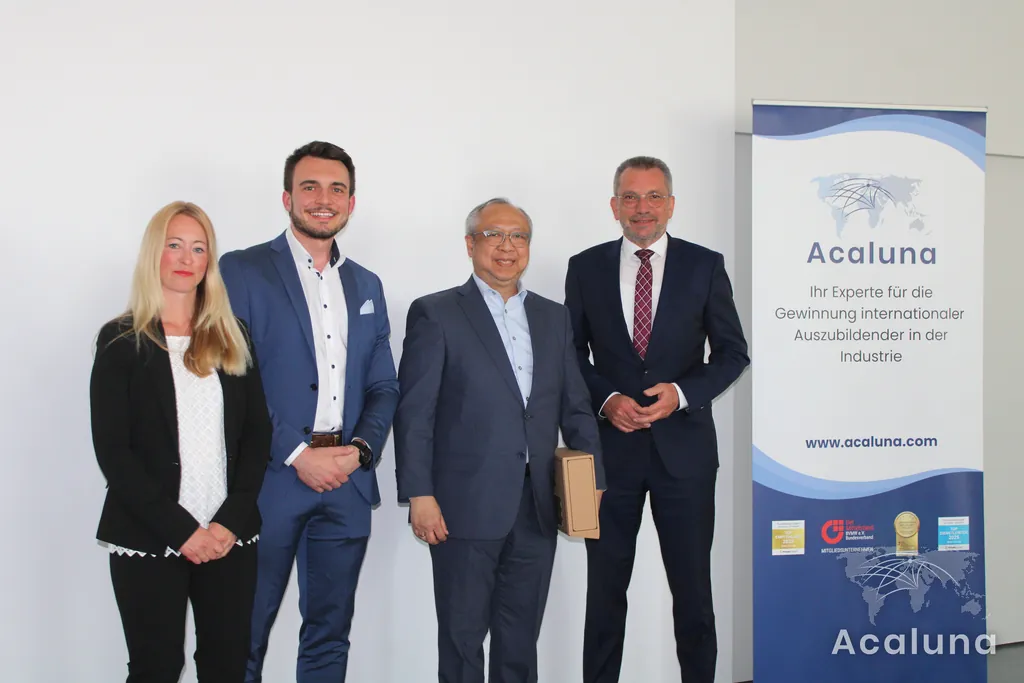 Indonesian Consul Generalvisited our office, 2025
Press
Schwäbische Zeitungreported on Acaluna, April 2025
HRB 746028
German companyregistered at Ulm District Court
Indonesian Consul Generalvisited our office, 2025
Press
Schwäbische Zeitungreported on Acaluna, April 2025
HRB 746028
German companyregistered at Ulm District Court
- German name
- Industrieisolierer
- Duration
- 3 years
- Field
- Industrial services and insulation
- Where you work
- Power stations, refineries, chemical plants, ships and industrial buildings
- Training pay
- 1,266 euros a month on average in industry (2025)
- Language
- German, usually B1 for the visa

What you do every day
- Measuring pipes, tanks and plants on site
- Cutting and shaping sheet metal for insulation cladding
- Fitting insulation materials and their cladding
- Working on scaffolding and at height with safety equipment
- Reading technical drawings and working with the project team
Pay during the Ausbildung
In industrial companies covered by a collective agreement (Tarifvertrag), the average training pay in 2025 was 1,266 euros gross a month across all training years, according to the Federal Institute for Vocational Education and Training (BIBB). The exact amount depends on the company, the region and the year of training. The legal minimum for an Ausbildung starting in 2026 is 724 euros a month in the first year.
These are gross figures. Social insurance contributions are deducted, and living costs in Germany are high. Our salary guide shows what is left after rent, food and insurance. For the visa, your training pay should be at least 1,048 euros gross a month (2026), otherwise you have to show extra funds.
Working hours and shifts
You usually work during the day. Because projects take place at different sites, you are sometimes away for a few days. Many companies pay an extra allowance for this.
Career after the Ausbildung
Experienced insulators are in high demand. You can become a team leader, site supervisor or go on to the Meister qualification.
After the Ausbildung you can stay in Germany as a skilled worker. In many industrial professions, skilled workers earn more than twice the training pay. Read after the Ausbildung for the residence rules.
This profession suits you if …
- You like physical work and working with your hands
- You are not afraid of heights
- You enjoy changing project sites
It may not suit you if …
- You are looking for office work
- You do not want to travel for projects
Questions about this Ausbildung
The Ausbildung as industrial insulator (Industrieisolierer) takes 3 years. It is a dual training: most of the week you work in the company, the rest you spend at a vocational school. With very good results, the training can sometimes be shortened.
According to BIBB, the average in industry and trade was 1,266 euros gross a month in 2025 in companies with a collective agreement, averaged across all training years. Pay rises every year of the training. The legal minimum in the first year is 724 euros a month for a start in 2026.
Yes. From outside the EU you need a training contract with a German company, German at level B1 and a visa for vocational training. Because few German school-leavers know this profession, companies are often open to applicants from abroad. Vocational school and the final exam are in German.
Interested in this profession?
Acaluna places apprentices from Indonesia in this profession with German companies that commission us. If you live in Indonesia, have finished 12 years of school and hold a German B1 certificate, check in one minute whether you can apply.
Pay: Federal Institute for Vocational Education and Training (BIBB), collectively agreed training pay 2025. Profession details: Federal Employment Agency (BERUFENET). Status: September 2026. Which professions we offer each year depends on the needs of the companies that commission us. Also available in Bahasa Indonesia.
More guides
Costs and scams
What you really pay, what you should never pay and how to check an offer.
Life in Germany as an apprentice
Small towns, winter, halal food, Ramadan on shift and homesickness.
After the Ausbildung
Staying on, the job search permit, permanent residence and salary.
How to choose a recruitment agency
What agencies may charge, the warning signs and the questions to ask.
Apprentice stories and reviews
Videos, original reviews and photos from our apprentices in Germany.
Ausbildung in Germany: the complete guide
How the system works, who can apply from abroad and where most applicants go wrong.
Is an Ausbildung in Germany realistic for you?
Seven questions, one minute, an honest answer: what you already have, what is still missing and whether we can place you. We are also preparing a step-by-step online course for applicants from every country.